"For now we are young let us lay in the sun and count every beautiful thing we can see" Neutral Milk Hotel.

Thursday, 26 June 2014

Flower favourites

Working at Holme Dunes today gave me the opportunity to view three of my favourite, but very different, flowers.
First, while checking the ponies in the West Field I noticed several plants of Grass Vetchling. Although, as the name implies, the leaves merge in with the grasses, the bright crimson single flowers shine out.
Second, while walking the butterfly transect I encountered good numbers of Marsh Helleborines in full flower. Although the plants give the general impression of dirty white, on closer inspection each flower is incredibly detailed - debatably the best flower of all our orchids.
Third, when walking behind the dunes towards Thornham estuary I passed by  a patch of Sea-holly plants, a few of which had flowering heads. A truly unique British wild flower, surprisingly a member of the Apiaceae (Carrot Family).
Other items of interest today were some plants of Wild Onion on Thornham Bank, a young Lapwing strolling in front of Hide 3 and a beautiful bright orange Dark-green Fritillary in the dunes (which flew away and hid before I could get my camera on to it!)

 Grass Vetchling Lathyrus nissolia
 
 
Marsh Helleborine Epipactis palustris
 
 
Sea-holly Eryngium maritimum


Young Lapwing


Wednesday, 25 June 2014

Hedge-cutting in summer!

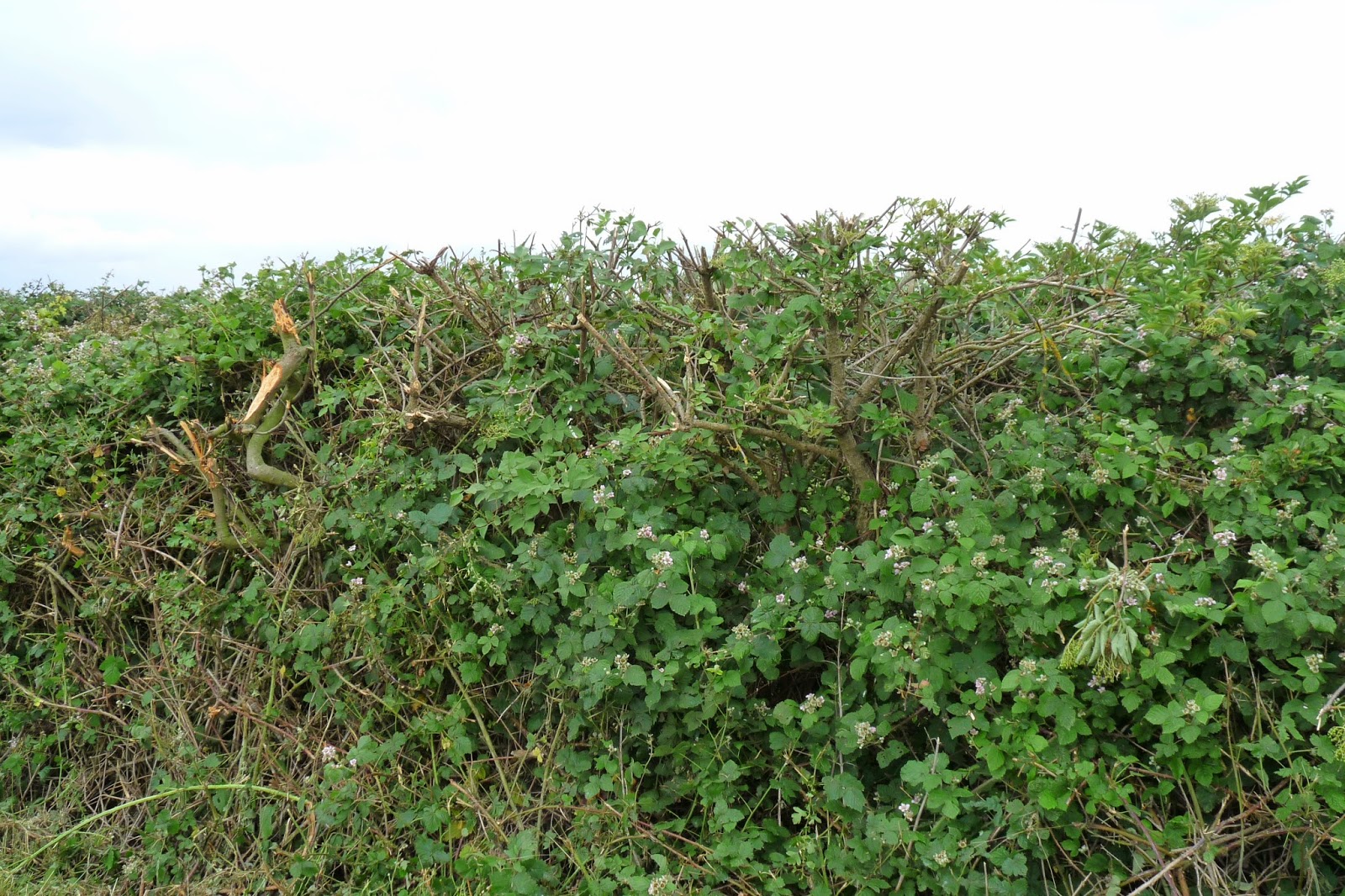
On Monday I noticed that this hedge along Hunstanton Road, Heacham from the entrance to Heacham Manor up to the A149 had been cut/chopped down. Whoever is responsible is clearly irresponsible and has no consideration for nesting birds at this time of year. If active birds nests have been destroyed then whoever cut the hedge has broken the law.


A sunny walk at Holme Dunes

A lovely sunny day for 26 walkers to join me on a West Norfolk NWT walk around Holme Dunes looking at summer flowers and butterflies.  Many flowers were in full bloom, including the Pyramidal Orchids, all the Marsh Orchids and the Marsh Helleborines. A few Bee Orchids were still in flower. Some other plants were beginning to dry up and go to seed, especially the Hop Trefoil. We were able to see a good selection of saltmarsh plants in "flotsam corner" by the Saltings. A young Common Lizard was hiding in the flotsam.
There were a lot of butterflies on the wing but of limited species i.e. Meadow Brown, Ringlet, Small Heath, Small Skipper, Red Admiral, Speckled Wood and Green-veined White. 
Some of the group spent some time watching an Ichneumon Fly Rhyssa persuasoria drilling holes into pine trunks with its ovipositor to lay eggs in horntail larvae. (I was not there and so don't have any photos).
After the walk I had a little wander around and found a few solitary bees buzzing around in the dunes. I managed to get a photo of one which I believe could be Megachile maritima, a leaf-cutter bee which has dilated front legs. I also found one new plant for the patch this year, some white Canterbury-bells by the path to the first hide. These have appeared for the last few years and presumably are an escape from somewhere.

 A pair of Ringlet butterflies

A leaf-cutter bee Megachile maritime ?

White Canterbury-bells Campanula medium

Current Clearwing!

We've had a really good invert filled time on the patch recently and the run continued this weekend with one of my Clearwings targets falling within seconds of hanging up the TIP pheromone lure - Current Clearwing!!!


Monday, 23 June 2014

Monday 23rd June 2014

Small Angle Shades, Hunstanton, 23rd June 


Buff Arches, Hunstanton, 23rd June 2014


Purple Clay, Holme NOA, 23rd June, 2014


Red Bartsia, Ringstead Downs, 23rd June 2014


Musk Thistle, Ringstead Downs, 23rd June 2014


Spear Thistle, Ringstead Downs, 23rd June 2014


Long-stalked Cranesbill, Ringstead Downs, 23rd June 2014


Sitochroa verticalis, Hunstanton (caught by Keith & Joan Fox), 23rd June 2014


Common Footman, Hunstanton, 23rd June 2014


Burnished Brass, Hunstanton, 23rd June 2014


A tachined fly, Ringstead Downs, 23rd June 2014


Saturday, 21 June 2014

Just a little to add!

Well just a few bits to add to Andy & Robert's comprehensive account from Saturday.

Surprisingly, from Gore Pt around 8am there was a few things moving. A Spoonbill flew east, a 1st sum Little Gull west, plus 9 Curlew, 2 Sand martin west. Plus Redpoll & Grey Wag flew over calling, high and heard only. With a few Starlings and Lapwings also west. But clearly post breeding birds are already on the move.

A repeat of one of Andy's shots but such a great looking moth!

Bordered White

A plant and several inverts from Saturday 21st June

Sixteen-spot Ladybird, Redwell Marsh, 16th June 2014


An unidentified picture-winged Fly, Redwell Marsh, 21st June 2014


Narrow-bordered Five Spot Burnet, Holme Dunes NWT, 21st June 2014


Sphaerophoria scripta, Holme NOA, 21st June 2014


Bordered White, Holme NOA, 21st June 2014


Flecked General Stratiomys singularior (a soldier fly), Holme Dunes NWT, 21st June 2014


Unidentified Ichneumon (huge !) Holme Dunes NWT, 21st June 2014


Unidentfied Sawfly, Holme Dunes NWT, 21st June 2014


Stinking Iris, Holmhurst Track, 21st June 2014


Large Skipper, Holmhurst Track, 21st June 2014


Currant Clearwing, Holmhurst Track, 21st June 2014


Friday, 20 June 2014

A selection of plants and invertebrates from the past week

Asparagus Beetle, Holme Dunes NWT, 19h June 2014


Shoulder-striped Wainscot, Hunstanton, 20th June 2014


Broom, Holme NOA, 20th June 2014


Dusky Brocade, Holme NOA, 20th June 2014


Bishop's Mitre Shieldbug, Holme NWT, 20th June 2014


Lesser Water Parsnip, Redwell Marsh, 19th June 2014


Great Mullein, Hunstanton, 17th June 2014


Perforate ST. John's Wort, Hunstanton, 17th June 2014


Marsh Dock, Redwell Marsh, 19th June 2014


Amphibious Bistort, Redwell Marsh, 19th June 2014


Attitudes to biodiversity which shame the area

Here's a shot showing the latest treatment meted out to the verges which 'guard' the southern entrance to Hunstanton.


Remember that superb display of wildflowers - Common Broomrape, Wild Clary, Yarrow, Perforate St. John's Wort and much else besides - cut down in its prime for no good reason at all. No wonder insult is added to injury and the virtually featureless green plains (our now sorry excuses for verges) are ploughed and seeded with 'wild' flowers brought in from some foreign field. Who on earth thought this a good idea ?

Note that any of the usual nonsense about road safety can't apply, as all the cuttings were just strewn in the road and left to block the drains too. A good use of taxpayers' money ?

And this isn't the half of it. In response to a note letting those who might be responsible for the upkeep of the grounds of a certain Hunstanton church know of the rich display of Meadow Saxifrage in their grounds, we were invited to dig the plants up given our evident fascination with them !

Then there's what is now called (as a sign informs us) 'Park Piece' in Holme - once a superb field and home to a precious Natterjack population - one of very few in Britain and Ireland - and a blaze of colourful luxuriance in the spring and early summer. It becomes ever more vandalised each year - treated as if it's some urban park.  First cut in half - fenced and one half ploughed - and now grazed by an assortment of pets. A big hole has been dug at one end (though the new scrape is a nice touch) and most recently, a rocky monolith has appeared (a huge piece of stone brought in from some far -away place which seems to have little to do with Norfolk, let alone Holme) and much of what remains of the wild-flower-studded field has been mown down. So much for the finest display of Grass-leaved Vetchling in the northwest of Norfolk. A flat green plain strewn with drying cuttings is so much better, isn't it ? Maybe the Natterjacks think so. Was it mown under licence I wonder ?

And don't get me started on the virtual destruction of the small, ancient field to the north of the River Hun and immediately to the east of the road bridge in Holme village, where a pond has been infilled and many of the undulations evened out to form - yes - another featureless grass plain. But this time adorned with hundreds of metres of fencing which subdivide it into a myriad paddocks. The area, apparently, housed the remains of an elaborate Saxon fish trap. Hard to tell now.

And finally (but only for now, I fear) the  River Hun is now all but devoid of aquatic plants for much of its length. Apparently, the amount of silt deposited is so huge that the substrate is now wholly unsuitable for supporting plant growth. And no, it has nothing to do with the storm surge - the damage started in earnest last spring when a siltation 'event' (presumably following some mismanagement of land somewhere in the tiny catchment) smothered and then killed off the vegetation. So in its short length of about 3 miles, we manage to destroy one of the county's finest short rivers.

Shame on us.

Well written Andy & what a bloody disgrace. Just yet another outrageous example of a waste of taxpayers money combined with destruction of the environment. I will fire off a letter to the Hunstanton mag as well. Let me know if we can do that!! Chris


One to look out for........a Norfolk coast speciality

Meet Clanoptilus barnevillei, a malachite beetle virtually confined, in the UK, to the Nofolk coast and very numerous at the moment on flowers at Holme.


Clanoptilus barnevillei, Holme NWT, 19th June 2014


Clanoptilus barnevillei, Holme NWT, 19th June 2014